Governor Hochul has announced the winners of the seventh round of the Downtown Revitalization Initiative (DRI) in a series of events highlighting the significance of the DRI program in revitalizing communities across the State.
Launched in 2016, The Downtown Revitalization Initiative (DRI) has been envisioned as “a comprehensive approach to boosting local economies by transforming communities into vibrant neighborhoods where the next generation of New Yorkers will want to live, work and raise a family.”
The 2023 winners are as follows:
New York City: Long Island City
Long Island: Kings Park
Capital Region: Lake George
Mid-Hudson: White Plains
Southern Tier: Roxbury
Mohawk: Herkimer
Central New York: Cayuga, Aurora, and Union Springs
Finger Lakes: Waterloo
Western New York: Tonawanda
North Country: Lowville
Roxbury is the second municipality in the Catskills to receive a DRI award after Tannersville had been awarded in Round 5.
Having served on the Steering Committee for Roxbury’s DRI application, I emphasize the importance of transformative projects in revitalizing communities.
Home to the renowned Roxbury Motel, Plattekill Ski Resort and historic Shephard Hills Golf Course, the Town of Roxbury builds on the legacy of financier and railroad magnate Jay Gould and naturalist writer John Burroughs. Its two distinctive hamlets of Roxbury and Grand Gorge, situated at the confluence of major corridors along Routes 30 and 23 in the scenic Catskill Mountains, are connected by a passageway alongside the East Branch of Delaware River, and serve a diverse population of full and part-time residents as well as tourists from all over the world. The quaint small-town atmosphere, rich historic character, vibrant creative economy, and abundant outdoor recreational opportunities make the two hamlets an idyllic place to live, work and vacation. The relative proximity to major metropolitan areas enables remote work while at the same time cultivates resiliency and sustainability that builds on a long farming tradition.
Writers in the Mountains (WIM) presents Speechwriting and Storytelling with Felicity H. Barber, a weekend intensive held online Saturday and Sunday, April 22 and 23, 2023 from 9:30 a.m. to 12:30 noon. Once you register and pay, you will be given instructions on how to join the class.
Since the advent of TED, storytelling has become a buzzword. But it’s a trick speechwriters have been using for centuries to help speakers connect with audiences and persuade them of their message. In this intensive two-day course you will: learn the basics of speechwriting and how to use it to tell your story; learn how to take your story, structure it into something that works for an audience, and use language to make it more compelling; connect your story to a broader message that moves hearts and minds; practice telling your story to an audience. Join Felicity for this interactive session where you’ll learn the tricks of the speechwriting trade, tell some epic stories that share something important about who you are, and have some fun along the way.
Felicity Barber is Founder of Thoughtful Communications, a consultancy doing thought leadership, speechwriting, and training. She has spent more than a decade writing speeches and managing the executive communications of CEOs in financial services. Prior to starting her own business she wrote for the CEO of BlackRock, two Federal Reserve Presidents, and the CEO of Lloyd’s of London. She has won Cicero Awards for her speeches on financial regulation and culture in financial services and she is an advisory board member of the Professional Speechwriters Association. Fun fact: Felicity once wrote a book that was given as a gift to the late Queen Elizabeth II.
To register for this class, e-mail writersinthemountains@gmail.com. To register online, visit writersinthemountains.org. Class fee is $100.
Writers in the Mountains is a 501 ( c ) (3) not-for-profit organization with a mission to provide a nurturing environment for the practice, appreciation and sharing of creative writing. For more information, visit writersinthemountains.org.
“I have a feeling that in art the need to understand and the need to communicate are one,” remarked Hedda Sterne, revered Surrealist painter.
Coming out of a 14-month once in a century pandemic, we take a moment to reflect on this monumental experience and make sense of the changes we have witnessed around us thus far.
Artists have extraordinary perceptual abilities, an attribute that Marshall McLuhan referred to as “integral awareness,” something that will guide us through the process of re-gaining meaning in a post-pandemic world. Societal forces play their role as well in influencing the artistic product from idea to execution and reception of the artwork in the field as the artist and his or her social surroundings are interdependent.
The pandemic took a year out of our otherwise normal life – everything was turned upside down. The unexpected circumstance changed our mindset, and forced us to adapt like never before. It also provided the sudden opportunity to slow down and re-think priorities. The post-pandemic world will look a lot different than the pre-pandemic one.
But how exactly does the art world respond to this colossal transformation in our life?In her seminal book “Meaning and Expression: Toward a Sociology of Art,” first published in Germany in 1967, Hanna Levy Deinhard exemplarily illustrated how humans are able to distinguish in a work of art its visual expression from its meaning. While visual expression however remains relatively constant over time, its meaning is subject to change. Deinhard strived to reconcile the everlasting contradiction in art between the artwork as a timeless object and the artwork as an expression of its time.
March 7th marks the one-year anniversary since New York State declared the state of emergency as a result of the COVID-19 pandemic. On March 20th, 2020 statewide stay-at-home order was declared, all non-essential businesses were ordered to close, and all non-essential gatherings and events were canceled or postponed. A year later, vaccinations are well under way, and the economy is re-opening step-by-step. New York Forward website provides current information by industry and re-opening phase, travel advisory guidelines, hot spots, as well as testing and vaccination sites. The grim reality is that the U.S. surpassed 500,000 deaths from COVID-19 on February 22nd, which makes the virus the leading cause of death in the country, along with heart disease and cancer. John Hopkins University has a Coronavirus Resource Center where you can track more data.
Consumer spending habits have changed. The lockdown has forced everyone to rethink their priorities and make adjustments. After the initial panic buying in March, April and May last year, when staple products were flying off the shelves, consumers have shifted their attention to remodeling their homes for the era of the indefinite home office, and replaced restaurant and entertainment expenses with home cooking and streaming services. Casual fashion has replaced business suits, and masks have made lipstick irrelevant. These are some of the few pandemic induced lifestyle changes. Read more about consumer spending in the U.S. in this Brookings Institution study.
The most dramatic change in our lives over the past year has been not being able to travel and spend time with family. Another significant change has been remote work and remote learning as the new norm, with some companies announcing indefinite work from home policies. The essential workers of course cannot work remotely, and hence they have been deemed indispensable to keeping our economy and daily lives running.
A year later, we have adapted to wearing masks, using hand sanitizers, and staying six feet apart, while at the same time contemplating how the new normal would look like once the pandemic is over. Socializing in restaurants, cafes, theaters, museums, and art galleries is sorely missed, but there is light at the end of the tunnel.
Rapid testing and vaccinations are key to re-opening the economy. Google, for instance, is now offering its employees free weekly at home COVID-19 tests. Also, the company announced that its employees won’t return to office until September, and when they do, flexible work weeks will be assessed. Other companies have announced that a significant number of their employees could be working remotely over the next ten years, and some may work from home permanently.
The debate over work-life balance is taking on a new meaning as working from home has eliminated some of the boundaries, and over-work is common. According to an article published in Bloomberg last April, “America’s always-on work culture has reached new heights.” One cannot escape work.
As for team building, people are getting creative. Peek is launching a platform that will offer teams and clients the opportunity to share experiences other than business meetings, and connect in a cooking or mixology class, wine tasting, chess competitions, and other fun activities.
Almost a year since the lockdown, The New York Times reports that “There are hints that the economy has turned a corner: Retail sales jumped last month as the latest round of government aid began showing up in consumers’ bank accounts. New unemployment claims have declined from early January, though they remain high. Measures of business investment have picked up, a sign of confidence from corporate leaders.”
As reported by The New York Times, movie theaters in New York City will be permitted to open for the first time in nearly a year on March 5 at 25 percent of their maximum capacity, with no more than 50 people per screening – movie theaters in the rest of the State were permitted to open last October. Also, as reported in The New York Times, a public-private partnership, New York Arts Revival, was formed to bring back arts to life, offering pop-up performances spearheaded by the producers Scott Rudin and Jane Rosenthal, along with the New York State Council on the Arts. Since the pandemic started, employment in New York City’s arts sector has decreased by 66 percent.
As countries prepare to reopen their economies, the idea of introducing vaccine passports is seen by some as a way to facilitating traveling abroad and even gaining access to venues like restaurants and bars. Vaccination for vacation is an Internet meme that is catching on. There are however ethical concerns surrounding this issue, and it remains to be seen how it can be implemented.
Lifestyle changes that are here to stay: remote work, online shopping, cashless payments, telehealth, digitized operations, and reduced contact. This article in The Harvard Gazette tackles the question on everybody’s mind: What will the new post-pandemic normal look like? Some experts think that we may have a clear idea by the end of the summer if we don’t experience another outbreak in September.
ART CONVERSATION AND WRITING WORKSHOP WITH AUTHOR SIMONA DAVID
SATURDAY, SEPTEMBER 8, 2018, 1 – 2:30 PM
THE ZADOCK PRATT MUSEUM, 14540 MAIN STREET / RTE 23, PRATTSVILLE, NY
As guest of the Zadock Pratt Museum, Simona David, author of “How Art Is Made: In the Catskills” (2017), will talk about her experience interviewing artists, and discuss what moves and inspires the creative mind, how a new artistic project is born, how materials are used and different stylistic choices are made, how setbacks are dealt with, and how success is celebrated.
Ms. David will then teach a workshop on art writing, and discuss various research and writing techniques.
To register, call Pratt Museum at (518) 937-6120.
This event is funded in part with public funds from the New York State Council on the Arts with the support of Governor Andrew Cuomo and the New York State Legislature.




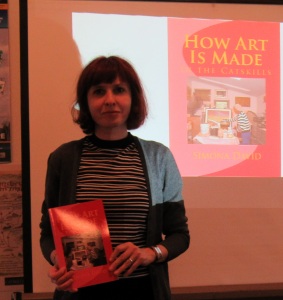 Catskills” (2017), will talk about her experience interviewing artists, and discuss what moves and inspires the creative mind, how a new artistic project is born, how materials are used and different stylistic choices are made, how setbacks are dealt with, and how success is celebrated.
 Simona David Consulting